The Heavens and the Earth הַשָּׁמַיִם וְהָאָרֶץ
You’ve read this phrase a hundred times
“In the beginning God created the heaven and the earth.” You have read this phrase a hundred times on this site alone. This page slows down on it. When the Bible says “heaven and earth,” is it pointing at the sky and the dirt, or naming something? Two words, side by side, all through Scripture. This page follows what they do together.
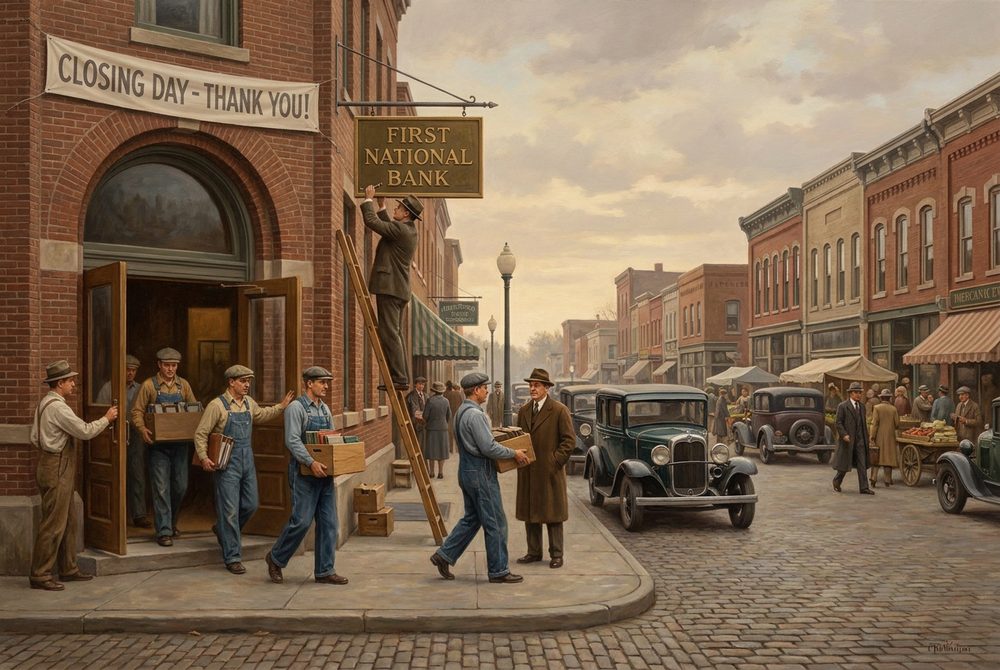
Sign coming down, boxes carried out. The street stays just as busy as ever. A world can end while the street goes on. When the papers say “the firm collapsed,” no bricks fall.
“Heaven and earth” does the same kind of work, verse after verse, all through the Bible.
One house, one King
Throne and footstool are furniture in the same room. One seated King, one house: heaven the inner room, earth the place where his feet rest. Start Here first raised this; this page is the fuller case. And when the Bible first shows you this house furnished and inhabited, you are not looking at outer space. You are standing in a garden.
The witnesses
The phrase does more than one job. It names courtroom witnesses in Moses and a throne-and-footstool house in Isaiah: one household of uses, not one flat meaning.
In Moses’ covenant papers, heaven and earth are the witnesses at the signing, the way a deed calls in two names to stand behind it. When Israel breaks the covenant, the prophets call the witnesses back into court. Isaiah opens his whole book that way: heavens and earth, called to hear the case.
When a world ends
Jeremiah watches Genesis 1:2 run backward over Judah’s judgment: without form and void, lights out. But verse 27 says the planet kept turning: “yet will I not make a full end.” A world ended. The ground stayed under everyone’s feet.
This one is in Israel’s own covenant papers, the same chapter as “I will walk among you” (Leviticus 26:12). Your heaven, your earth. A people has a heavens-and-earth, and it can be blessed or broken. Nobody reads this as sky turning to metal. And the idiom isn’t Israel’s private property, either:
Edom’s judgment is the subject, and Edom’s fall dissolved no actual stars. Most of us brought an assumption to Genesis 1:1: that “the heavens and the earth” just means the material universe. Test that assumption against these texts and it is the one that bends. Judah’s world goes dark while the ground holds. Israel’s heaven turns to iron while the sky stays sky. Edom’s host falls while the constellations keep their places. The language sits naturally once you let it name what it keeps naming: a people’s ordered world, its heaven and its earth, throne-room and ground.
Worn out, and planted
God “plants” heavens here, with the very same verb, nata, that plants the garden in Genesis 2:8. Nata is Hebrew’s ordinary planting verb, so the echo is suggestive, one thread among several, not a proof by itself. And the sentence ends not on stars and soil, but on people: “Say unto Zion, Thou art my people.” The verse right before sets the scene: “But I am the LORD thy God, that divided the sea” (Isaiah 51:15), the exodus. God is talking about the founding of Israel. Words put in a mouth, a people covered by his hand, heavens planted, earth founded, Zion named his own. Planting heaven and earth turns out to mean making a people.
GO DEEPER: What Jesus and the apostles do with it
What Jesus and the apostles do with it
Two “tills,” one horizon: heaven and earth passing, the law being fulfilled. What passes when all is fulfilled? Jesus leaves that as a question to sit with.
Peter counts the worlds
Peter counts three: the world that then was, the heavens and earth which are now, and the new heavens and earth he still looks for. The first one is the key. “The world that then was… perished,” in the flood. Yet Noah stepped out of the ark onto the same ground; the planet didn’t go anywhere. So by Peter’s own arithmetic, a heavens-and-earth has already perished once without the universe ending. One world was gone, and the same mud was still on Noah’s boots. And what fills the new one he waits for is not new geology. “Wherein dwelleth righteousness.” This chapter is argued over in good faith, and this page isn’t settling it. But Peter’s own first example sets the rule for how these words can work.
Genesis answered: a new house, God at home with man. The phrase has been walking toward this since the first sentence of the Bible. When this happens is your question to keep asking; this page isn’t answering it for you.
This word names the whole sky Genesis 1 opens under, the frame every other star in that chapter hangs inside.
Open the heavens →"The heaven and the earth" is the Hebrew way of saying everything there is, the physical universe, and Genesis 1:1 records its beginning.
The pair names God's ordered house, throne and footstool, a world a people can lose while the sky stays, and Genesis 1:1 founds that house.
The word shamayim never by itself “means” covenant order. No dictionary says that, and neither does this site. The question is always what a given text is doing with the pair, and that test cuts both ways. “Heavens and earth means the material universe” is also a reading, not a given, and it has to face the same texts: Leviticus 26:19, Isaiah 34:4, Jeremiah 4. This page has shown why we think that assumption is the one that bends; the verses are here, so weigh it yourself. Isaiah 51:16’s planting is read other ways by good readers. Peter’s chapter, 2 Peter 3, is argued over in good faith; this page pointed only at the flood, his own first example, not a timeline. God made the sky and the land: see what we affirm. The question this page asks is which texts are teaching that, and which are doing something more.