Tanninim תַּנִּינִם
The monster on the first page
When Genesis uses its weightiest verb again, bara, create, the first creature it names is the tannin. Around ancient Israel, the nations told fearful stories about the sea-dragon, the chaos monster the gods had to battle before the world could stand. Genesis writes one line, and the monster turns out to be a creature, made by God. Then God blesses it.
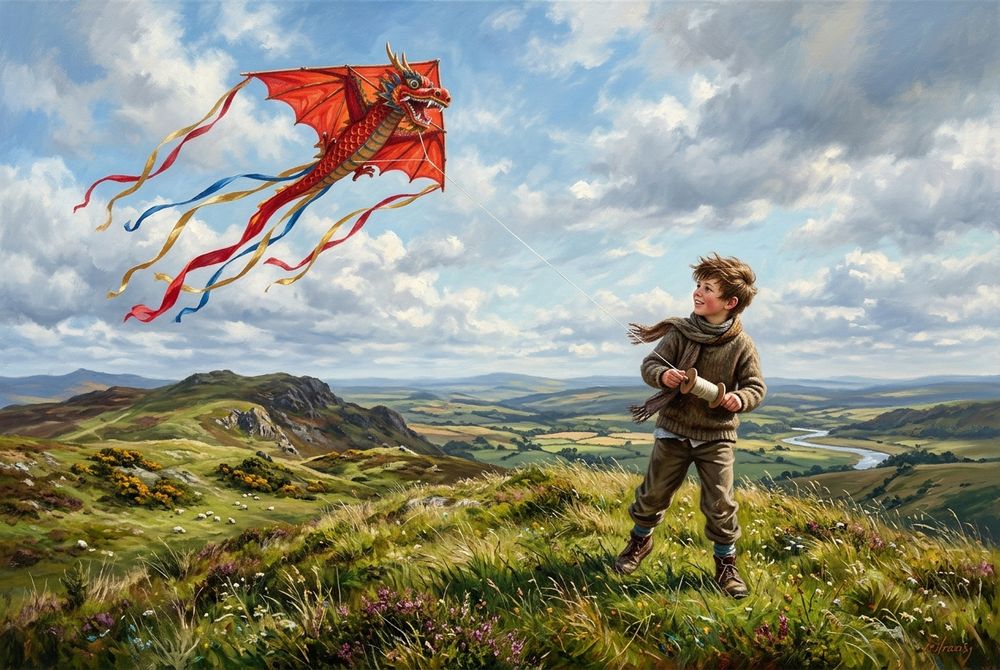
Fearsome shape, scarlet wings, and a string running down to a boy’s hands. The terror of the skies is a made thing on a tether. Day five answers the dragon-myths about that quietly.
What the prophets do with the word
In the prophets, the tannin is Pharaoh: the empire in the water, boasting that the river is its own.
When Isaiah and the psalmist retell the exodus, they tell it as dragon-slaying: Egypt is the wounded monster, the sea split over its head. The tannin is the standing picture of the hostile power, and day five says those powers were never rival gods. They are creatures, under God’s hand from the first page. He even blesses them (Genesis 1:22).
Daniel sees them come up from the sea
Ezekiel pointed at one king and called him the dragon in the water. Daniel looks at the same water and sees four. Then his vision does something unusual: it explains itself.
Wind on deep water. Monsters climbing out of it. Daniel asks what he is looking at, and he is told.
The key is handed over in one line. The monsters are kings. The water they come out of is the restless world of the nations. Ezekiel made that move once, with one dragon and one Pharaoh. Daniel makes it a system: four beasts, four kingdoms, one sea. The sea itself has its own page; the section on what the water pictures is on tohu wa-bohu.
Then John writes, and he writes in Daniel’s vocabulary. He stands on the shore and “saw a beast rise up out of the sea” (Revelation 13:1). Same water, same direction. And the one beast he sees is stitched together out of Daniel’s four. It is “like unto a leopard,” its “feet were as the feet of a bear,” its “mouth as the mouth of a lion” (Revelation 13:2). Daniel had watched a lion, then a bear, then a leopard come up one at a time (Daniel 7:4-6). John sees them arrive in a single body.
Is John reading Daniel? Readers have thought so for a very long time, and you can see why. This page does not say what John’s beast points at, and it does not settle the arguments about it. It shows the grammar the two visions share: deep water, monsters, and kings. What that grammar carries is yours to weigh. The serpent’s own thread through the Bible is traced on nachash.
GO DEEPER: The dragon’s last chapters
The dragon’s last chapter
Ezekiel already called Pharaoh “the great dragon” (Ezekiel 29:3, above). Revelation uses the same English words at the story’s end.
The monster-word keeps naming powers that set themselves against God’s people, chapter after chapter. In the end, it is cast down.
The end of the monsters
Back to where the page started. Genesis 1:21 says God created the great sea-creatures, and then blessed them (Genesis 1:22). They were never his rivals. The last pages of the Bible say the same thing, in a harder key.
The verb matters. The dragon is not fought to a draw. He is laid hold on, taken, the way you take hold of something that cannot get away from you. This is no duel between equals. It is a creature being handled.
So the deep-water things that have been terrorizing the story go into the fire. The dragon goes in. Then death goes in after him, the thing that has been following the man ever since the garden gate closed. The head Genesis said would be crushed is on her seed; the man who answers the death is on the last Adam.
And the thousand years, sitting right in the middle of those verses? Every question you have about it stays where this site leaves timing questions: open. This page does not say when, or how long, or what the binding looks like on a calendar. It is making a much smaller point, and it is the point day five made first: the monster is a creature.
The tanninim swim in Day 5’s corner of the night sky, beside the birds and fish.
Open the heavens →"Great whales" are the large sea animals God made on day five, and the verse is plain natural history with nothing political in view.
Tannin is the prophets' word for the empire in the water, and day five names it first among God's creatures: never a rival god.
Real sea-creatures are real, and Genesis means they are God’s. The answer to the myths only works because the creatures are creatures. (A tannin can be an ordinary serpent too; Aaron’s rod becomes one in Exodus 7.) “Leviathan” is a different Hebrew word from tannin. The two swim in the same poetry, and Isaiah 27:1 stacks the names side by side, but they are not the same word. That is association, not identification.
Daniel never uses the word tannin. His word for what climbs out of the water is simply “beasts,” and that part of his book is written in Aramaic, not Hebrew. So the bridge back to Genesis 1 there is not the vocabulary. It is the sea, and the fact that Daniel decodes his monsters as kings, the move Ezekiel already made with Pharaoh. The bridge is shown above; what it carries is your call. And Revelation 20 is one of the most argued-over chapters in the Bible. This page quotes it and stops, and takes no position on the thousand years.