Breath נְשָׁמָה
A borrowed breath
God forms the man from dust, and dust cannot breathe on its own. So God does something dust cannot do. He breathes (naphach, to breathe into) into the man’s nostrils. What goes in is called neshamah, breath. The man’s first breath was not his own. It came from someone else’s mouth.
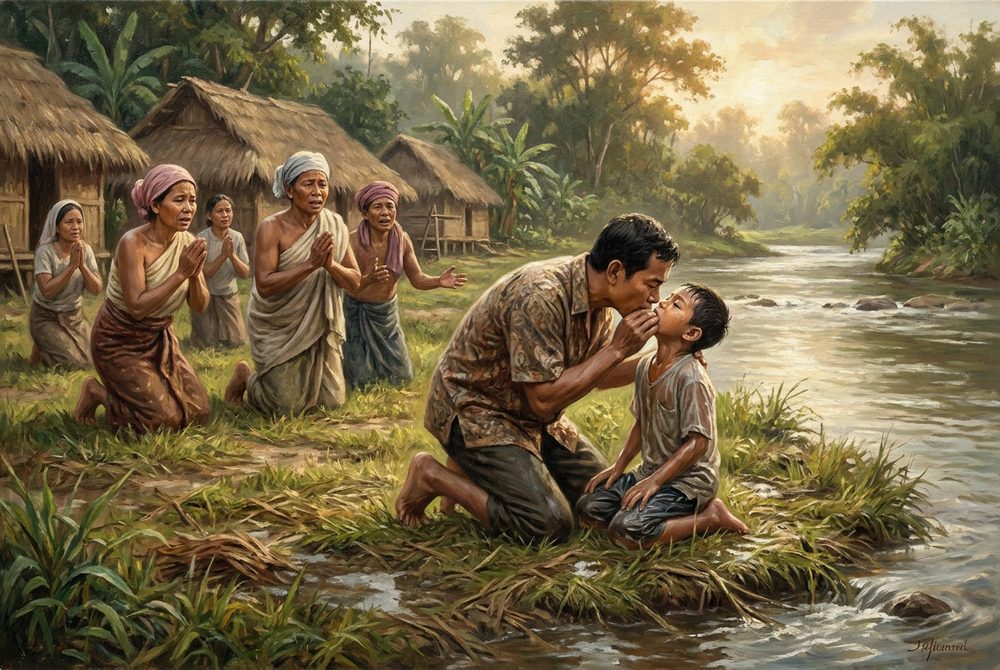
At the riverbank, someone kneels down and breathes for a person who can’t breathe alone. That air didn’t start in those lungs. It came from a mouth that chose to give it. Genesis 2:7 is that picture, close up: God kneeling over dust, giving his own breath.
Not the breath’s alone
Neshamah, breath, is not a word Scripture saves for man. Genesis 7:22 gives that same word to every land animal that drowned in the flood. They had “the breath of life” in their nostrils too. The noun by itself doesn’t set man apart, and nothing below leans on it.
What’s rare isn’t the noun. It’s the verb doing this particular work. Naphach is a rare verb, and most of its uses are ordinary blowing: fanning a fire (Ezekiel 22:21), scattering what’s brought home (Haggai 1:9). God’s breath gives life with this verb just twice in the whole Hebrew Bible, here and in Ezekiel 37.
Twice, in the whole Bible
The second time is Ezekiel 37, the valley of dry bones. God tells the prophet to call to the breath itself and command it to breathe on the slain.
And the bones have a name: “Son of man, these bones are the whole house of Israel” (Ezekiel 37:11). Here the breath is summoned by command, “Come from the four winds, O breath,” rather than breathed directly, as in the garden. Even so, the second time this breath gives life, what comes back isn’t one man. It’s a covenant people, bone to bone. Scripture’s second use of the breath says what kind of act the first one was: a people-making act.
The breath, breathed again
After the resurrection, Jesus does it once more.
Long before Jesus, Genesis was translated into Greek. Where 2:7 says God “breathed,” that translation uses one word: emphysaō. That Greek word appears once in the whole New Testament, and this is the place. A garden again, and a new people again. We think John chose it on purpose. The order repeats three times, too. Adam is breathed alive, then planted in a garden. Israel is breathed back to life in Ezekiel’s vision, then promised a sanctuary (Ezekiel 37:26–28). The disciples are breathed on, then sent to build the church. Breath first, house after. (More on this thread: the last Adam.)
GO DEEPER: WHEN SCRIPTURE CALLS PEOPLE ANIMALS
The concession above, that the animals had neshamah too, is less flat than it sounds. Scripture speaks of people as animals all the time, and means it. “All we like sheep have gone astray” (Isaiah 53:6). “O generation of vipers” (Matthew 3:7). A king eats grass as the oxen do when his kingdom is taken from him (Daniel 4:33). God tells Israel to their face, “ye my flock, the flock of my pasture, are men” (adam, Ezekiel 34:31). Whether the flood’s every-breathing-thing stays inside that habit is a real question, and how to read this book is about this way of speaking. The concession stands anyway, since the case above never needed it. The animals don’t settle the question either way.
Breath stands right beside dust in the sunrise sky: the giving that answers the forming.
Open this scene’s sky →God's breath gives the first human being physical life, and with it the soul or spirit that sets people apart from the animals.
The same rare, direct breath raises the house of Israel in Ezekiel 37, so Genesis 2:7 founds a covenant man and his people.
The breath-noun, neshamah, is shared with the animals, and the claim never rests on it. Whether “the animals” is as flat a category as it sounds is an open question, since Scripture keeps calling people sheep, vipers, and oxen. The claim rests on the verb, with God as its subject, and that is a set of two in the whole Hebrew Bible. A set of two is a small set. The Greek-translation bridge to John 20:22 is real, but it’s a translator’s choice, not a Hebrew word matching a Hebrew word. Breath alone doesn’t decide what Genesis 2 is about. It’s one thread in the sanctuary pattern (Genesis 2).