The River נָהָר
Which way the water runs
Genesis 2:10 says a nahar, river, went out of Eden to water the garden, then parted into four heads that reach out toward the world. The direction matters. The water doesn’t drain into Eden from somewhere else. It rises inside Eden and flows out. Whatever Eden is, it is a source, not a low point collecting runoff. Gold and onyx lie along its banks too, the very metal and stone the priests will later wear and work with.
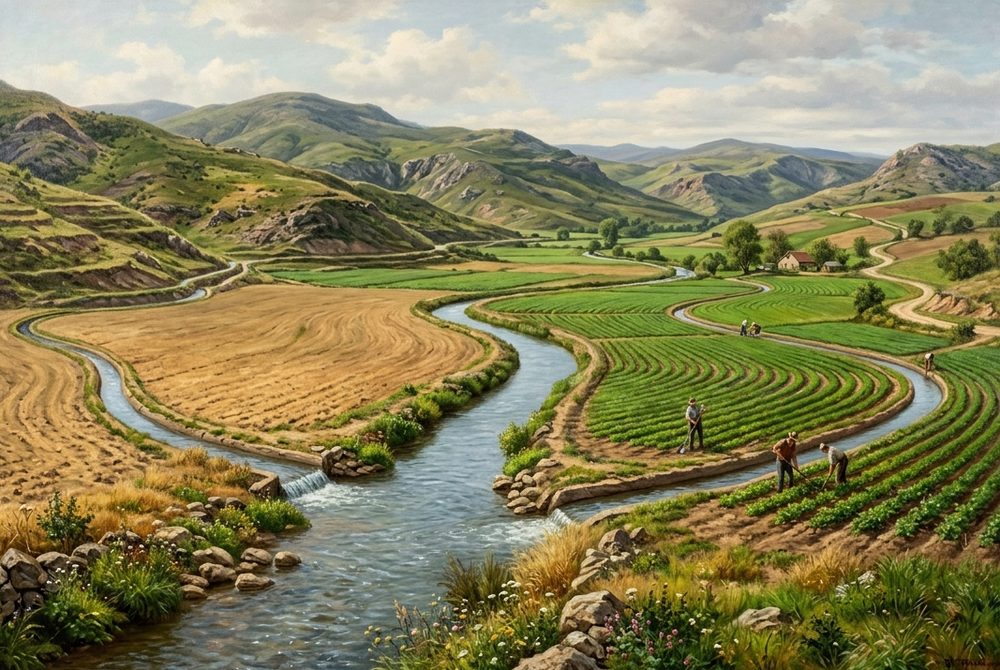
One spring, four channels, and the dry fields go green wherever the water reaches. That’s Eden’s river, spelled out in a farmer’s language.
The river, measured
Genesis names the river in two verses and moves on. Ezekiel doesn’t. In chapter 47 he is shown a river pouring out from under the temple. Then he is walked into it, deeper and deeper, until he can no longer stand.
From under the threshold, eastward: ankle-deep, then knees, then waist, then a river no one can wade through. It isn’t fed by rain or another stream. It comes from the sanctuary itself.
Wherever this river goes, Ezekiel says, everything lives. It even heals the sea.
Fishers stand at a sea that used to be dead, unable to keep up with what it hands them. The Hebrew word for “fishers” here is rare enough to check by hand. It surfaces in only one other verse in the whole Bible, and there it is not good news. In Jeremiah 16:16 God sends fishers to catch a fleeing people, in judgment. Same word, opposite job. That thread, and where it turns up again among working fishermen on a different shore, is followed on birds & fish.
Trees line the banks, with leaves that never fade and fruit that never runs out, “because their waters they issued out of the sanctuary.” Ezekiel’s river is Eden’s river, grown up: the same source, the house; the same direction, out; the same effect, life wherever it reaches.
The river now, in people
Revelation runs the same picture once more. A river of water of life now flows straight from “the throne of God and of the Lamb.” The same tree and the same leaves are there, now “for the healing of the nations.”
Jesus stands up at a feast and says the river isn’t just out there anymore, in a garden or a temple. It’s in people: “out of his belly shall flow rivers of living water.” John doesn’t leave the reader guessing what the water is. He says it outright: the Spirit.
Where the water rises now
Jesus had already said it quietly, to one woman at a well. The water he gives doesn’t just reach a person. It rises in them, “springing up.” That moves the source. In Genesis the water rises in the garden-house. In Ezekiel it rises from under the threshold of the house. If the water rises in people now, where is the house?
Paul answers without a riddle. Built on the apostles and prophets, with Jesus himself the corner stone, the whole building grows into “an holy temple in the Lord,” “an habitation of God through the Spirit.” This is the same promise the walking page ends on: “I will dwell in them, and walk in them.” The house Genesis opened, God at home with man, is now a people. The garden was the first address. It was never the last one.
The river runs bright through the center of the sunrise sky: Eden’s water traced all the way to Ezekiel’s temple and the throne.
Open this scene’s sky →The river is a real river in real geography, with the Tigris and Euphrates among its four heads, placing Eden on the ancient map.
The river is water rising inside God's house and flowing out to give life, the picture Ezekiel, John, and Revelation all carry forward.
Genesis doesn’t cite Ezekiel, and Ezekiel doesn’t cite Genesis. Genesis’s word is nahar; Ezekiel’s is nachal, a different Hebrew word. The bridge is a shared picture, not a shared word: water from the house, flowing out, giving life. John 4’s word is a well, a spring, not a river; John 7 is where the river returns. The family on this page is pictures running one direction, water in the house and then water in the people. It is shown as that, not as a chain of quotations. Revelation reruns the same scene from the throne. Ezekiel’s temple vision (chapters 40–48) holds far more than this page explains: measurements, land lines, offerings. None of that is settled here. The four rivers’ geography (Pison, Gihon, Hiddekel, Euphrates) is a real puzzle, and this page leaves it open. The “fishers” link to Jeremiah 16:16 is a shared word, not a shared message. Two verses do not make a pattern by themselves. Jeremiah’s fishers are sent in judgment, and Ezekiel’s stand at a sea already healed. The page shows the word and leaves the verdict to the reader.