On talking foxes
Nobody sat by the fire believing foxes could talk. Not the Greeks who first told Aesop's fables, not the grandmothers who passed them down, not the children who heard them. And yet everyone knew Aesop was telling the truth about real things: flattery, greed, patience, pride. The fox who sneered at the grapes he couldn't reach was never a fox. He was your neighbor. He was you.
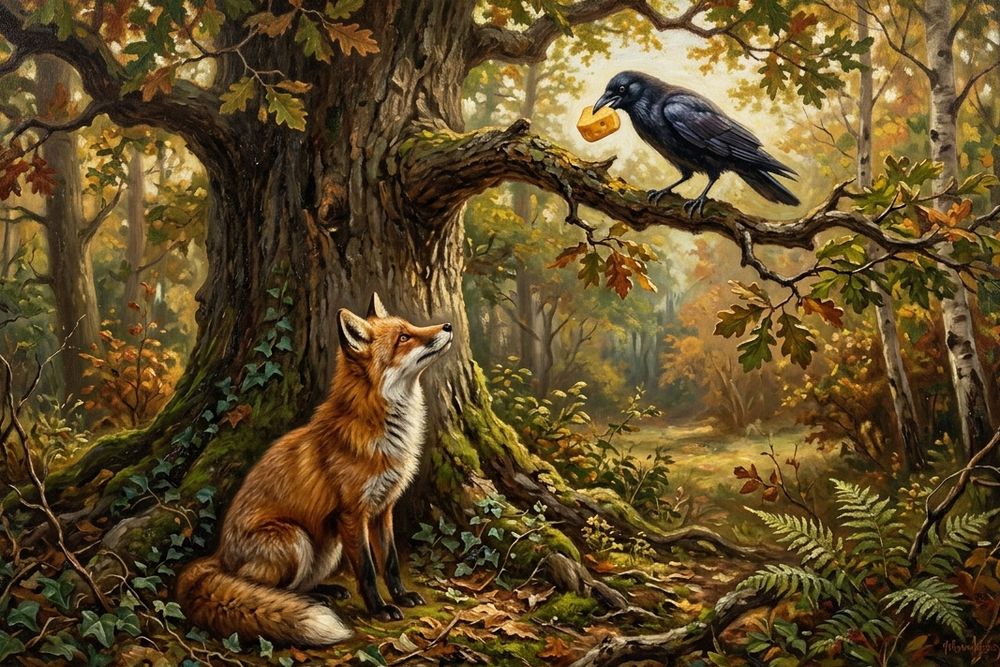
"Sing for me," said the fox. The crow opened her beak and lost her supper. No one asked whether foxes can speak. Everyone asked whether they had ever been flattered.
This is an old, ordinary way of speaking truly. Animals stand for people. A vineyard stands for a nation. Stars stand for a family. Ask Joseph's family. He told them his dream of the sun, the moon, and eleven stars bowing down. His father decoded it on the spot: father, mother, and brothers (Genesis 37). Nobody in that tent said, "But stars don't bow." They knew the language, because it was their language.
We are the ones who lost it, and we lost it twice. We stopped knowing the real things the pictures come from. Most of us have never kept a vineyard, saved seed corn, or watched a shepherd work. And we stopped reading the old stories that trained the ear: the fables, the fairy tales, the parables told by firelight. So the Bible speaks in pictures: a serpent in a garden, a dragon in the river, lights hung for feast days. And we ask a question the first hearers never asked. But did the fox really talk?
A picture is not a lie, and a picture does not erase a fact. The prophet Nathan once told King David about a poor man's one little lamb, stolen by a rich man for a feast. There was no lamb. It was still the truest thing said in that palace all year. The story found the fact and drove it home: "Thou art the man." The picture wasn't a substitute for the truth. The picture was how the truth got in.
To be clear, Genesis is not Aesop. A fable is made up to carry a lesson. Scripture's pictures are given to carry facts: covenants cut, a people founded, an exile suffered. The language is the fable's language. What it carries is real.
This site will show you that "create" usually founds a people. That the sea gives birth to empires. That a garden is furnished like a sanctuary. The question is never whether God could make oceans and stars. He did, and we say so. The question is what these particular pages are teaching, and whether we can still hear their language the way Joseph's brothers heard his. Learn the tongue, and the first pages of the Bible open like a door.
Two questions you can check in your own Bible: what does "create" do, and what are "the heavens and the earth"?
Try the door →