The Open Rest מְנוּחָה
Start with something you already know
Think about the last day of a build. The saws go quiet and the toolbox shuts. But nobody thinks the builder is done because he’s tired. He stops because the house is ready. Then he does the thing the whole job was for. He carries in a chair, sets it by the fire, and sits down in a house that is now his home. Rest, in this sense, is not lying down. It is taking up residence.
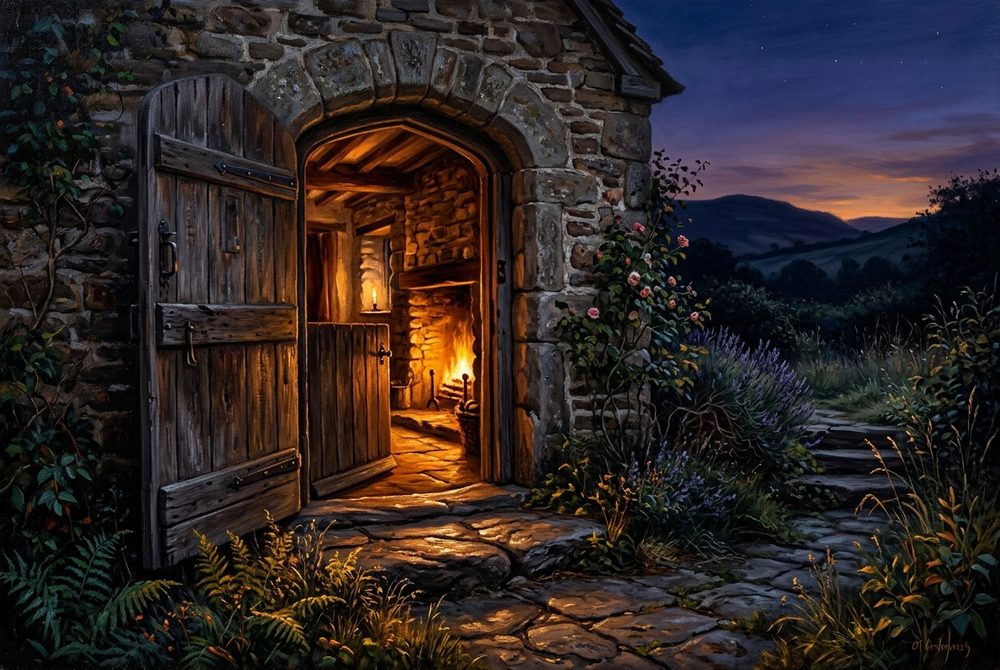
The fire is lit inside, and the door is standing open. Nobody has shut it. This page keeps coming back to that picture: a rest you can still walk into.
The day nobody closed
This one takes about a minute to check. Six times in Genesis 1 the same sentence closes a day: “And the evening and the morning were the first day,” then the second, the third, on through the sixth. It is the chapter’s own punctuation mark.
The closing line is missing from those two verses. Six days get an evening and a morning. The seventh gets blessed, gets made holy, and never gets shut. The shabat page walks through what the resting itself means: the finished house, the King moving in. This page picks up the other half: the rest words themselves, and where they say the door is.
Rest is a place
Hebrew has a noun for rest, menuchah, and it is not mainly about how a tired body feels. It is the settled place at the end of the journey: the land Israel is walking toward, the spot where the ark finally sets down. One psalm defines it out loud.
“This is my rest… here will I dwell.” The psalm puts the definition right next to the word. God’s rest is somewhere he lives. You can walk into it, and you can be shut out of it. Another psalm says that is what happened.
A generation stood at the edge of it and did not go in. That is a strange thing to say about a nap. It is an ordinary thing to say about a door.
Hebrews finds the door still open
Centuries later a New Testament writer picks up Psalm 95 and makes an argument out of the timing. God said “my rest” to Israel in the wilderness. Then, long after, he said it again through David: “To day.” Why say it again if the door had already closed?
Then comes the sentence, and with it a switch of vocabulary you can see in the Greek. For eight verses the writer has used one word for rest, katapausis, the Greek Old Testament’s standard word for menuchah. At the climax he swaps it for a word built straight out of “sabbath.”
That word, sabbatismos, a sabbath-keeping, appears once in the whole New Testament, and this is the place. The writer had a perfectly good word already and chose a rarer one at the one moment he wanted you to hear “sabbath.” The very next verse ties it back to Genesis by hand: whoever enters that rest “hath ceased from his own works, as God did from his” (Hebrews 4:10). The seventh day is not being remembered. It is being offered.
A promise is left to them, something a person might come short of. You cannot come short of an event that finished long ago and closed behind you.
GO DEEPER: THE INVITATION
The invitation
The Greek word Jesus uses here is a different one from Hebrews’ word, so there is no word-link to claim. The link is the posture. The rest is spoken of as something a person walks into, on invitation, from where they are standing right now. It is not a day on a calendar behind us but a door being held open.
This page doesn’t say who has entered, or when. It only shows the two small things the words themselves say. The seventh day was never closed, and the rest is spoken of as still open. What you do with the open door is yours.
Day 7 stands at the eastern edge of the Genesis 1 sky, the one day the chapter never puts to bed.
Open the heavens →"Rested" means God ceased from creating on a seventh day that came and went like the other six, the pattern for the weekly Sabbath.
God's rest (menuchah) is a dwelling he takes up in the finished house, and the seventh day has no evening because that rest stayed open.
Hebrews 3–4 is a dense argument, and careful readers take it different ways. Some read a promise of heaven, some the gospel rest of faith, some a future age, some all three at once. This page doesn’t settle that, and nobody settles it in a paragraph. What this page shows is smaller and checkable. The seventh day has no recorded sunset in the text. The New Testament speaks of that rest as something still open at the time of writing. Two more limits. The missing “evening and morning” is an argument from silence: a real observation, but silence. Some readers say the formula simply wasn’t needed once the days were done. Menuchah does sometimes mean ordinary rest, as when Ruth is wished a settled home; the place-sense is its center of gravity, not its only use. This page makes no claim about when anyone enters. That question is still yours.