Dust עָפָר
Formed outside, brought in
The man is formed “of the dust of the ground.” Then, says the next verse, God put him in the garden. He was made outside and brought in. That detail matters, because dust in the Bible is not just what things are made of. It is a place a person can be sent back to.
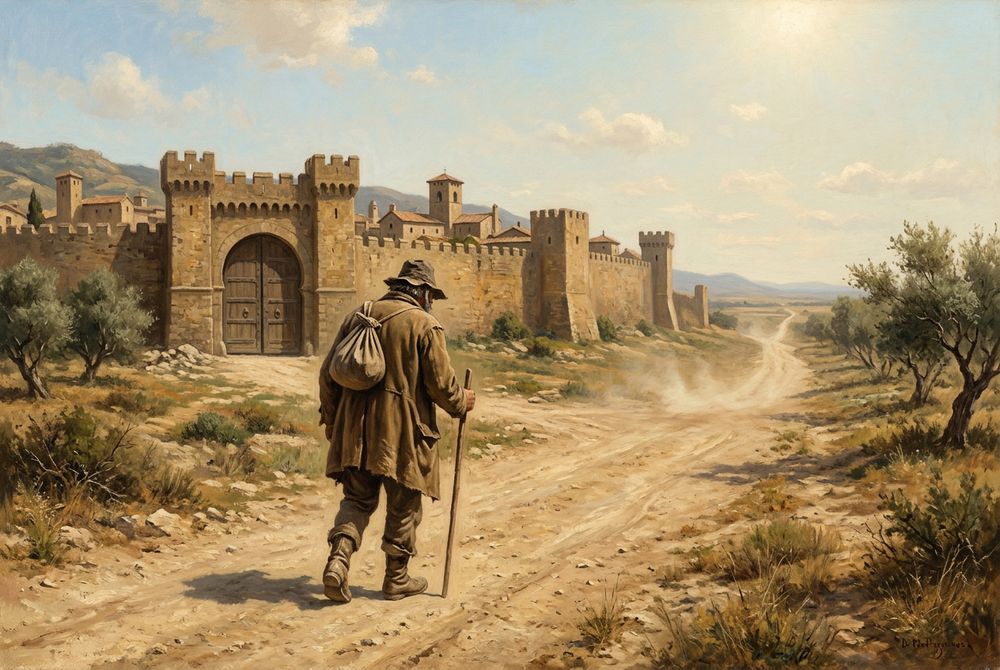
Dust on his coat, the town gate shut behind him. In the Bible, to sit in the dust is to be outside: humbled, exiled, far from home. And to be raised from the dust is to come home.
Two ways the Bible uses dust
Isaiah tells captive Zion to shake herself from the dust. Dust is where captives sit, and rising from it is coming home from exile.
Both registers are real, and both are here. Psalm 103’s dust is how fragile we are, said tenderly. Isaiah’s dust is the captive’s seat, and rising from it is the way home. (Isaiah 26:19 is a big verse with its own story. It is quoted here only for where its sleepers lie: in dust, awaiting rising.) Genesis has the shape of the second in view too. A man is taken from the dust outside and placed in God’s garden. When the covenant breaks, he is sent back out to it. Our reading is that the Bible’s exile-from-the-sanctuary thread starts here. It runs forward to the east side of the garden, and on to Genesis 3’s garash, the driving-out itself. So is “unto dust shalt thou return” a biology lesson, or an exile order? The next verses narrate a sending-out, east of the garden.
Dust is not destiny
Dust is where the exile sits, but dust is not destiny. Paul traces the dust-man’s line all the way to its end: a second man, from heaven. First and second name the two heads, not two places in a head count. The line that started “of the dust of the ground” is carried, in Christ, into the image of the heavenly.
Dust anchors the forming-corner of the sunrise sky, beside the breath that answered it.
Open this scene’s sky →"Unto dust shalt thou return" is the sentence of physical death: the body God made from soil will decay back into soil.
Dust is where the humbled and the exiled sit, so this is a sentence of exile from God's sanctuary, carried out in the next verses.
Bodies do return to the ground. Ecclesiastes says so with the same word, and Psalm 103’s gentle sense is real. The question is which way Genesis 3:19 speaks. This site reads it as a sentence, carried out by expulsion in the verses that follow. Genesis 3:19 and 3:23–24, read together, are the place to weigh that.