The Two Trees עֵץ
An open house, one rule
Genesis 2:9 plants “every tree that is pleasant to the sight and good for food” in the garden, and right in the middle, one more: the tree of life. Two verses later, God gives the man exactly one rule. Every etz, tree, is his to eat, except one. Etz is just the ordinary Hebrew word for tree, so what makes these two trees matter isn’t the word. It’s where they stand, and what they’re for.
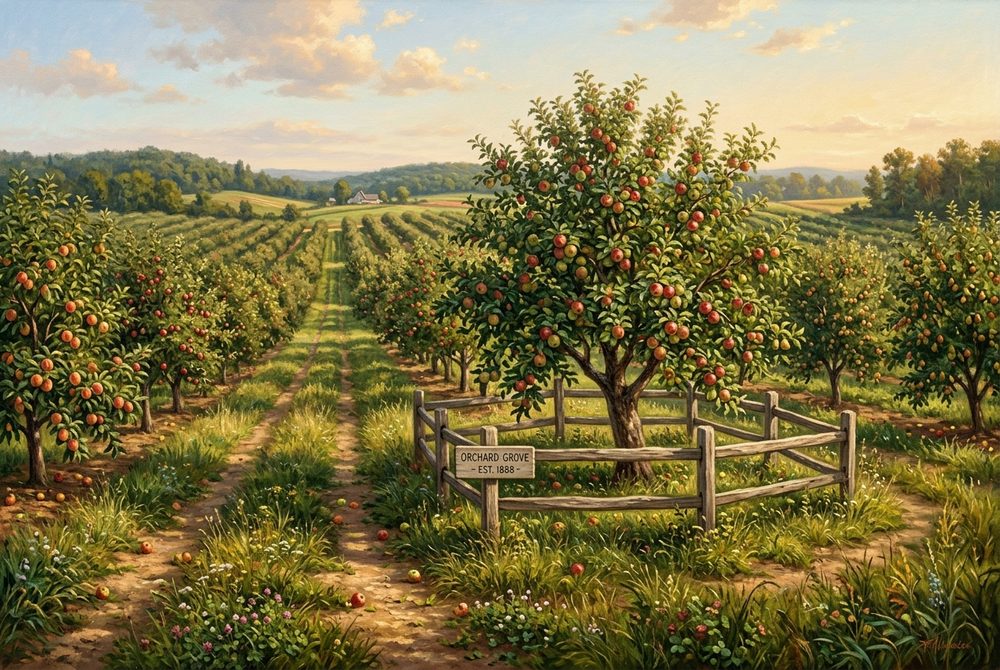
Walk the whole orchard and eat from every row, except the one tree behind the low fence. Everything else stands open, and one thing is marked. That’s the shape of Genesis 2:16–17.
Generosity first
The order the rule comes in tells you something. “Of every tree of the garden thou mayest freely eat” is said before the one thing withheld. The rule isn’t the point of the garden. The giving is. God fences one tree, one tree wide, out of an entire orchard he just handed over.
The tree at the center of the tent
The tabernacle keeps something like a tree at its center too. Exodus never uses the word etz for it. But the lampstand at the heart of God’s house is hammered gold, “of beaten work,” with a “shaft, and his branches, his bowls, his knops, and his flowers.” Its branches carry cups “made like unto almonds, with a knop and a flower” (Exodus 25:31–33). Branches, buds, and blossoms, shaped like the almond tree, one of the first to bloom in an Israelite spring. Exodus never calls it a tree. It built one anyway, in gold, and set it burning at the middle of the house.
Wisdom’s own book uses the same picture: covenant wisdom is a tree of life, to be taken hold of with both hands.
A puzzle Genesis leaves standing
The text leaves one thing unexplained. After the man and woman eat from the wrong tree, God moves to keep them from the other one too, “lest he put forth his hand, and take also of the tree of life, and eat, and live for ever.” But Adam was already alive. He’d been alive the whole time, without ever eating from the tree of life. So what would eating from it now have given him? Whatever that tree offers, it’s more than the life Adam already had. It is a fuller, unending kind of life, the kind covenant life is meant to reach. Genesis poses the puzzle and doesn’t stop to answer it.
The tree, unfenced
The Bible’s last chapter puts the tree of life back in view.
No fence this time. The tree grows by a river, its leaves “for the healing of the nations.” The last blessing in the whole Bible is for those who may “have right to the tree of life” and walk in through the gates. The story that opened with one fenced tree closes with the same tree standing open.
The two trees mark the center of the sunrise sky: one open, one fenced, both circling the garden’s middle.
Open this scene’s sky →The two trees are literal trees in a literal garden, and eating from the tree of life would have kept the first couple alive forever.
The two trees are covenant furniture: life at the center of God's house, like the almond lampstand, and one term that decides who stays.
Genesis never calls the lampstand a tree, and Exodus never calls the tree a lampstand. The almond-tree lamp is Exodus’s own picture, and this page shows a pattern, not a proof. Nothing here rides on the botany of two literal trees; the claim is about what the trees do in the covenant story. Readers who take the trees materially can walk this whole page and keep their view.