Image εἰκών
Whose face is on it?
Before it was ever a theology word, eikōn was an everyday one. It is the portrait stamped on a coin. When Jesus holds up a denarius and asks, “Whose is this image and superscription?” (Matthew 22:20), image there is eikōn. The face on the metal tells you whose the coin is and whose authority it carries.
It is also the word the old Greek Old Testament uses in Genesis 1:27, where God makes man in his image. So when the New Testament writers use eikōn, they are picking up Genesis’s own vocabulary, in the Greek their readers read.
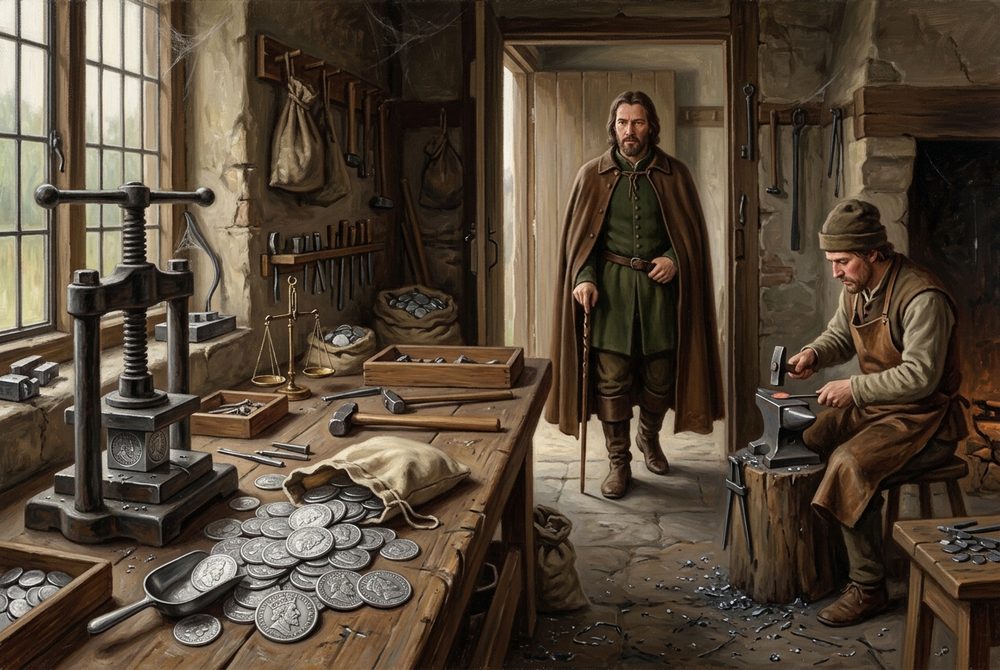
Every coin in the province carries the portrait. That is how a place a thousand miles away knows whose rule it lives under. Then one morning the door opens and the face itself walks in, and every coin in every pocket suddenly makes sense.
The office, filled
Genesis handed out the image as a job: God’s representative, set up in God’s place, so the world would meet the King in him. Paul says Christ is “the image of the invisible God” (Colossians 1:15), not a man who carries the image but the image itself. That verse belongs to another page, and it is worked out there: the image of God, in Genesis 1.
This page follows what happens next. Once the office is filled in person, the New Testament starts talking about a family being shaped to match.
A family with the family face
The last clause explains the first. Why conform anybody to the Son’s image? So that he would be the firstborn among many brethren. Firstborn is family language, and it needs a family to be first in. The image here is not a decoration hung on individuals. It is a household resemblance, brothers who look like their eldest brother.
Changed while you look
Two things stand out in that verse. The first is we all. Paul has just been talking about a veil, and here the whole company stands with faces uncovered. The second is the direction of travel: from glory to glory. Something is moving. Elsewhere Paul says the same thing with Genesis’s own words: believers are “renewed in knowledge after the image of him that created him” (Colossians 3:10). That is day six’s language, used of people being changed now.
Two portraits, and which one you wear
Same word, twice, in one line, and the two images are named by two men. “The earthy” is the dust-man, and Paul has a rare word for him that he uses nowhere else in the Bible. That word is next door: choikos, of dust. The short version of this page runs like this. Genesis gave the image as an office. The New Testament shows the office filled in person, and a family being grown into the likeness, carrying one portrait now and promised another.
The Image stands twice in the sky, once on day six and once at dawn: the office given and the office filled.
Open the dawn sky →Every human being carries the image of God by nature (mind, conscience, soul), and being conformed to Christ's image is each believer's growth in holiness.
The image is a royal office, God's representative in God's place, filled in person by Christ and shared as a family likeness among his brothers.
The “conformed to the image” texts describe a work in motion. Christians differ over its stages: where it starts, how far it goes now, what is left for later. This word study shows the direction, not a diagram. Eikōn is not automatically a good word, either. Ten of its New Testament appearances are in Revelation, and every one of those is the image of the beast. An image can be counterfeited, which is part of why whose image matters. And when Paul calls Christ the image, that title may carry more than an office. This page traces the office thread and sets no ceiling on the rest.