“Be fruitful, and multiply” פְּרוּ וּרְבוּ
Listen for the echo
“Be fruitful, and multiply, and replenish the earth.” Genesis says it over the man and woman. Then listen for the echo down the whole book: God says it again to Noah stepping off the ark. To Abraham, in the covenant chapter. And in Egypt, Israel grows in exactly these words. It is a charter, and at fresh start after fresh start, the charter is renewed.
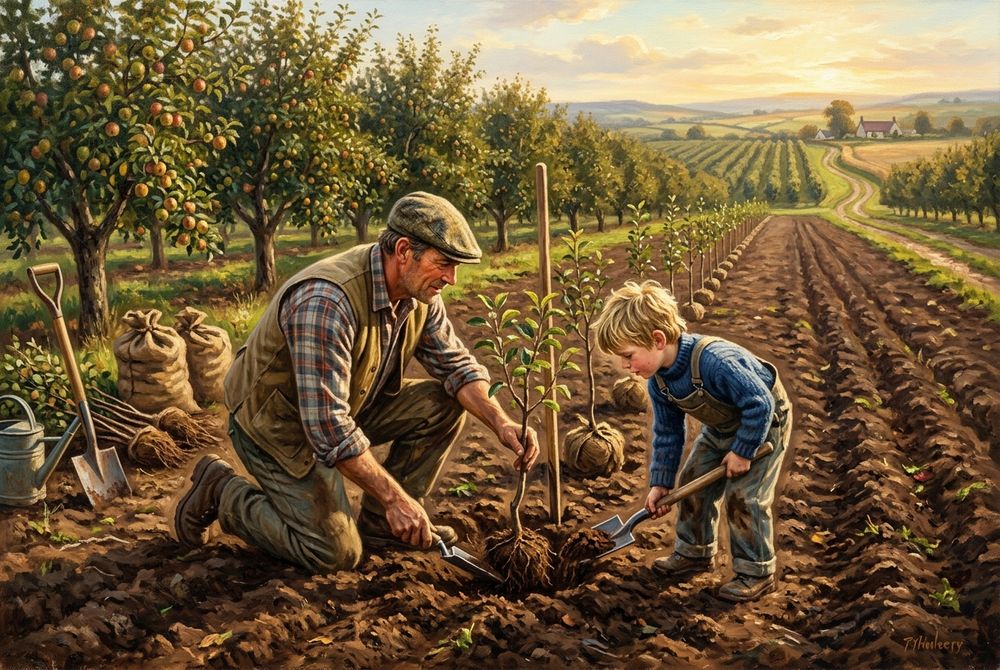
Every spring, another row from the same stock. An orchard is not a tree; it is a line of trees, planted outward on purpose. “Be fruitful” plants people that way.
The charter, re-issued
The ark empties, and the words of day six are spoken again, nearly letter for letter. A new beginning gets the old charter.
Exodus opens by telling Israel’s growth in day six’s own vocabulary: fruitful, multiplied, filled. The charter is functioning as covenant blessing, the growth of a people under promise.
And Babel is the charter refused: “fill the earth” answered with “lest we be scattered.” The story reads like it knows which command is being defied.
Whose fruit counts?
Adam was fruitful. That part worked the way you’d expect: he had sons. But the story follows only one of them.
Cain is Adam’s own son, first in line. John still calls him “of that wicked one.” Being born to the man charged to be fruitful didn’t make Cain the fruit the charter was after.
Eve doesn’t say “another son.” She says “another seed,” day three’s own word (see seed), already carrying a family line by Genesis 4. And Seth’s line is the one that starts calling on the LORD’s name (Genesis 4:26), not the one that built a city. Before Abraham is even born, the charter has already split: not everyone Adam fathered was the fruit it meant.
Jesus draws the same line out loud, centuries later.
Told his mother and brothers are outside, he doesn’t correct anyone’s biology. He redraws the family around obedience.
He grants the bloodline a few verses earlier, “I know that ye are Abraham’s seed” (John 8:37), and denies the sonship in the very next breath. Descent is one thing. Being a child is another.
Paul states as doctrine what Genesis 4 already showed in a story: flesh is not the same claim as promise. Cain was Adam’s flesh. Seth was the seed God appointed. John spells out how that second birth happens.
A real birth, in real people, the way a company or a marriage is real without being made of matter. It is not a birth you can trace with a family tree alone. So when the sower goes out to sow, the ground that matters is the one that “heareth the word... and beareth fruit” (Matthew 13:23). Multiplying was always going to mean that kind of increase, not only births counted on a census.
The charter, written over the church
Genesis 1 opens with a charter: be fruitful, multiply, fill the earth. Luke keeps borrowing its language, straight from the Greek Old Testament, in the book of Acts.
Increased, multiplied. The blessing found a new object: not just a family, but the word of God, and the people it makes.
The charter’s star stands with Adam and the Image in Day 6’s corner of the sky.
Open the heavens →God's first command to the human race is to have children and fill the planet, and that blessing on every family is still in force.
The same blessing is re-spoken at every covenant fresh start, so its fruit is the covenant line, a people grown under promise.
Children are in view. That is what the words say, and families have read them that way for as long as there have been families. This page’s point is the pattern of reuse: at every covenant fresh start, the same blessing is re-spoken over the covenant line. Both readings can be true at once, and the story keeps building on the second one.
Genesis 4 never calls Cain “the serpent’s seed” in those words. That phrase is 1 John 3:12, reading back onto the story; this page shows the connection John draws, not a label Genesis 4 uses itself. And this isn’t a bloodline test: Cain is Adam’s son throughout Genesis, no asterisk. The point is which child the story calls righteous, not who fathered whom. The line runs by faith and obedience, which is Paul’s own point in Romans 9, not a step past it.