Seed זֶרַע
An ordinary farming word, at first
Day three fills the land with plants “whose seed is in itself.” That is an ordinary farming word. Then Genesis starts doing something with it. Within two chapters, zera stops being about barley. There will be a seed of the woman, and a seed of Abraham. Paul will hang a whole argument on the word’s grammar.
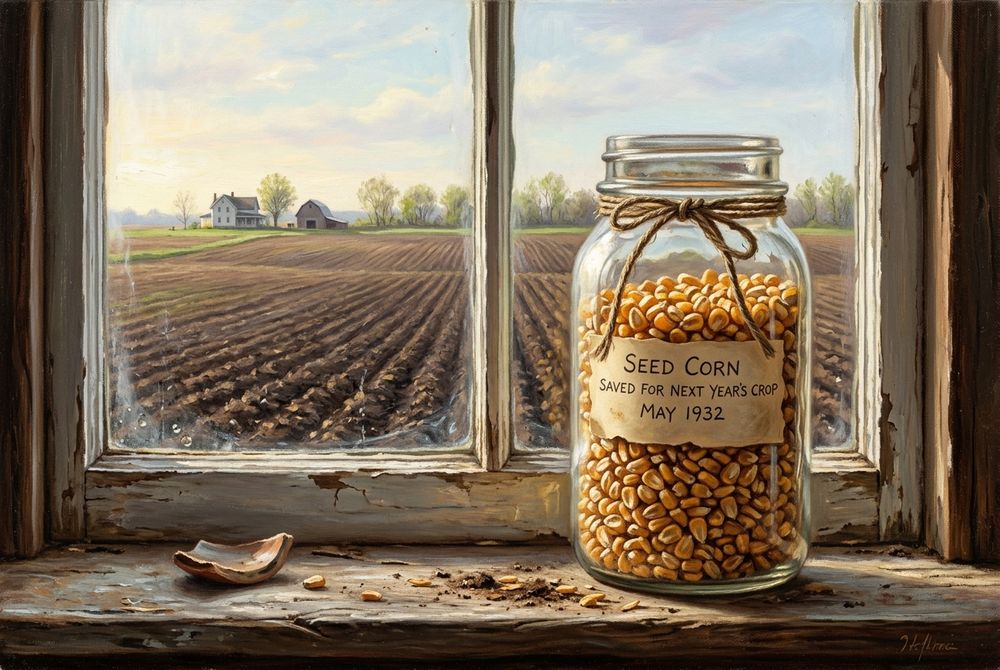
A jar on the windowsill, labeled in Grandpa’s hand. That jar isn’t lunch, it’s next year. A family keeps its future in seed. So does the Bible.
Where the word goes
Two chapters later, seed means offspring: two lines at war, with a promise riding on one of them.
Zera is a collective singular, like English “sheep.” It can mean one or many. Paul reads that as deliberate, and his argument in Galatians leans on it: the promise travels down the line to the Seed.
God sows a people
Farmers sow seed. In the prophets, God sows people. Jeremiah says it in one line, and he names both the field and the crop.
The seed here is not barley. It is the seed of adam. And the ground being planted is a people, the house of Israel and the house of Judah. God is the farmer. What he puts in the earth is a nation.
There is a second crop in the line: “the seed of beast.” That word, behemah, is Genesis 1’s own. It is the word the chapter uses for “cattle” at 1:24–26. (It is a different word from “beast of the earth,” chayah, two verses earlier, and the two stay separate here.) Jeremiah goes back into day six’s own vocabulary to describe what God plants. That pairing has a habit behind it. Scripture very often speaks of people as animals: sheep, vipers, a flock. Ezekiel can call God’s flock adam to their faces: “ye my flock, the flock of my pasture, are men” (Ezekiel 34:31). The Genesis 2 page on the breath walks through that habit at length. So is man-and-beast here a way of saying every living thing in the land? Or is it the Bible’s ordinary way of talking about a people? That question doesn’t get settled in a sentence. Either way the verb is the same: God sows.
Hosea says the same thing with a name.
One verse earlier, a chain of hearing ends on a name. The heavens hear, the earth hears the corn and the wine and the oil, “and they shall hear Jezreel” (Hosea 2:22). Jezreel is built out of this very word: zara, to sow, joined to El, God. The name means God sows. Hosea had hung that name on a son as a sign of judgment. Here the sign turns over and becomes a promise. The people who got scattered are the people who get planted.
Paul picks up Hosea’s line for the calling of the nations: “I will call them my people, which were not my people” (Romans 9:25–26). A sowing promise spoken over Israel gets read out over people who were never counted in.
GO DEEPER: Jesus and Paul sow too
Jesus keeps coming back to seed
A sower goes out to sow. Some seed gets eaten, some gets scorched, some gets choked, and some falls into good ground and comes up a hundredfold (Matthew 13:3–9). Then Jesus explains his own parable, and the picture opens all the way out.
The sower is a person. So is the seed: “The field is the world; the good seed are the children of the kingdom” (Matthew 13:38). Planted people again, in a field the size of the world.
Then he says it about himself, not long before the cross.
He could have gone to a courtroom or a battlefield for his picture. He goes to a field. When Jesus wants to explain the kingdom, and when he wants to explain his own dying, he uses day three’s vocabulary: sowing, seed, harvest.
Sown one way, raised another
Somebody asks Paul the hard question: “How are the dead raised up? and with what body do they come?” (1 Corinthians 15:35). He answers like a farmer.
Three things, in a row. What you sow has to die. What you sow is not the body that comes up; you put bare grain in the dirt and something else stands in the row. And the body is given: “God giveth it a body.” The farmer doesn’t pick it. He sows, and God decides what comes up.
That shifts the question. Paul isn’t asked what the dead body is made of, and he doesn’t answer that. He answers with what happens between sowing and harvest. Two words from this same chapter have their own pages here. One is the made-alive word behind “is not quickened” (zoopoieo). The other is the dust-word Paul uses a few verses later for the first man (choikos).
This sits close to Jeremiah. God says, “I will sow the house of Israel.” Paul answers a resurrection question with sowing and raising, and this site reads the covenant world as the thing being remade. Put those side by side and you get a reading: one covenant world sown, another one raised. The connection is shown here, not handed down as a verdict. This chapter carries several careful readings, and weighing them is yours to do.
Seed’s star stands with Earth & Seas in Day 3’s corner of the sky.
Open the heavens →"Seed" on day three means plant seed and nothing more; its later uses for offspring are a separate sense of a common noun.
Day three's seed is plant seed on its face, and the same word (zera) becomes Scripture's word for a family line God himself sows.
The word by itself never tells you one child or a nation. Context does, and sometimes the text keeps it open on purpose. Day three’s seed is, on its face, about plants; this page shows where the word goes from there. That the same word carries barley and the gospel is either coincidence or design, and the reader decides which.
Jeremiah 31:27’s sowing sits inside a restoration promise. The next verse says God will “build” and “plant” what he once plucked up (31:28), and the verse is kept in that setting here. First Corinthians 15 carries several careful readings, held by careful people; this page settles none of them. The bridge from Genesis to Jesus’ parables is a picture, not a lexicon entry. Jesus and Paul are speaking Greek, and their words are sperma and kokkos, not Hebrew zera. Whether the Greek Old Testament links them word-for-word has not been checked here, so no claim is made about it. What the page shows is one steady habit of speech: God plants people. It runs from day three to the prophets to a field the size of the world.