The Lights מְאֹרֹת · מֶמְשֶׁלֶת
Read day four’s next sentence
Most of us learned day four as decoration: sun, moon, stars, a nice sky. One verse further, day four hands the lights a job, and it names that job twice.
The Hebrew behind “to rule” is not a verb here. It is a noun with a small word in front of it, le-memshelet, “for the rule of.” Young’s Literal keeps the shape: “the great luminary for the rule of the day.” So day four does not only hang lamps. It hands out governments.
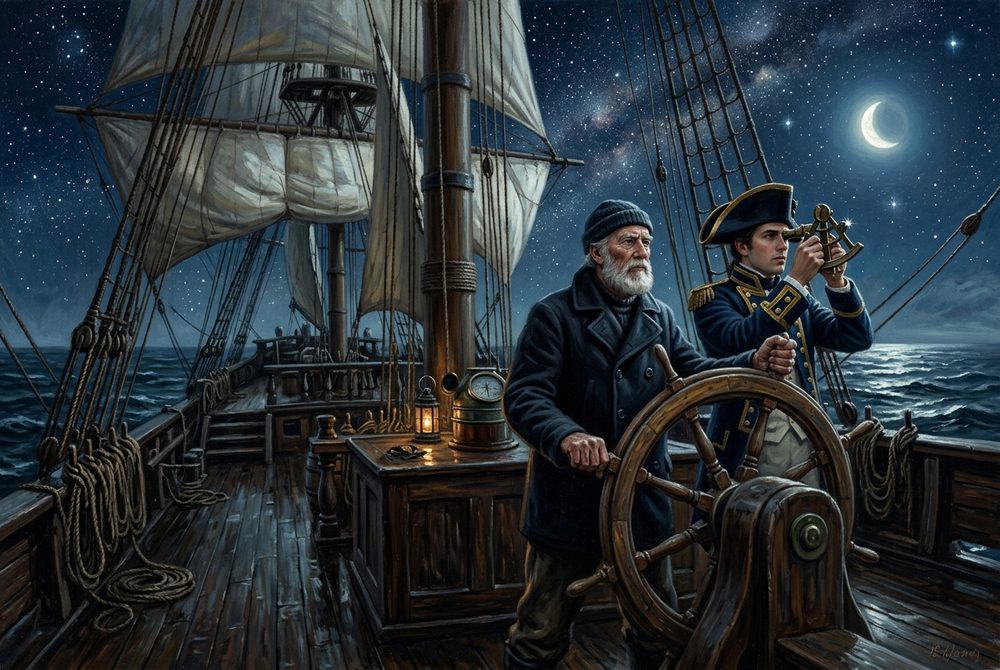
Nobody on that deck thinks the stars are just pretty. The whole voyage answers to them. Genesis 1:16 says the lights were hung to govern.
Day four gives the lights another job in the verse before this one, “for signs, and for seasons,” and that clause is a calendar. It has a page of its own: signs and seasons. Two pages, two questions: who rules, and what time it is.
A ruler’s word
Memshelet is not a common word. It shows up fewer than twenty times in the whole Hebrew Bible. Two of those are day four’s own lights, said over again in a psalm. Every other one is about somebody’s government: a king’s territory, a steward’s office, God’s own dominion. Start with the psalm.
Same word, same lights, said again on purpose. Next, the word does its ordinary work on a man.
One steward is being put out of office and another is being put in, with the robe, the sash, and the keys. The word for the thing changing hands is day four’s word. It keeps that company elsewhere: “Israel his dominion” (Psalm 114:2), and the promise that “the first dominion” comes back to Zion (Micah 4:8). A king’s territory, a steward’s office, a people governed: that is the neighborhood this word lives in.
Lights that stand for people
If the lights were given governments, it matters what happens the next time somebody in Scripture sees a sun, a moon, and stars together.
Joseph’s dream is Scripture’s first reuse of sun-moon-and-stars, and Jacob decodes it out loud, on the spot: “Shall I and thy mother and thy brethren indeed come to bow down ourselves to thee to the earth?” (Genesis 37:10). Father, mother, brothers: a covenant family, told in lights, with the question of who bows to whom sitting right in the middle of it. Nobody in the room thinks it is a dream about astronomy.
The same three lights come back near the end of the Bible, with a crown on.
Sun, moon, and twelve stars: Joseph’s family, grown into a nation.
And John does not leave his readers to guess at his stars. In his first chapter he stops and hands over the key himself.
Stars are the angels of the seven churches. Candlesticks are the churches themselves. Readers argue over who exactly those angels are, messengers carrying a letter to a congregation or something more, and this page doesn’t settle it. The decoding itself is John’s. He prints it before he asks anybody to follow him any further. In this book, a star can be somebody with a job.
Daniel had already put people in that sky: the wise “shall shine as the brightness of the firmament,” and those who turn many to righteousness shine “as the stars for ever and ever” (Daniel 12:3). The word for firmament there is day two’s own word (see raqia), and the set-apart people who shine in it are where hivdil ends. What Daniel’s verse settles, and when, is a real question, left open on both pages. The picture, though, is steady: the set-apart ones do what stars do.
GO DEEPER: WHEN THE LIGHTS GO OUT
When the lights go out
Now the hardest sky in the Bible: the one that goes dark.
The first line of that oracle explains its tenth. It opens, “The burden of Babylon” (Isaiah 13:1). It is a funeral for a kingdom. Egypt gets the same sky: “when I shall put thee out, I will cover the heaven, and make the stars thereof dark,” and “all the bright lights of heaven will I make dark over thee” (Ezekiel 32:7-8). Israel gets a noon that turns to night (Amos 8:9). Over each of them the actual sky kept shining. It was the kingdom’s lamp that went out. If the lights were handed governments on day four, then putting the lights out is how Scripture very often says a government fell.
Then Jesus sits down on the Mount of Olives. His disciples ask him a question, “when shall these things be?” (Matthew 24:3), and he answers them in this same language.
Every phrase there is borrowed. It is Babylon’s funeral language, and Egypt’s, in Jesus’ mouth. The last clause fits the same pattern: the powers of the heavens shall be shaken. Who or what he aims it at, and when, is the disciples’ own question, and a fair one. This page will not answer it. It shows where the words come from, so that whatever you conclude about the timing, you are deciding about the right kind of sentence.
The rulers, retired
Day four hung two governors over the day and the night. In the last picture the Bible gives us, both step down. They are not fired, and not darkened in judgment like Babylon’s or Egypt’s; they are just no longer needed. God himself is the light now, in the room they used to rule. The lights’ other job, the calendar they were also hung for, gets the same ending, walked out in full on signs and seasons.
The Lampstand is drawn in the night sky: seven covenant lamps hanging from Day 4’s own verse.
Open the heavens →"To rule" means the sun and moon govern day and night by giving light and marking time, a description of the sky God made.
"To rule" (memshelet) means government everywhere else it appears, so day four hands the lights offices, and later sun-moon-and-stars scenes are about rulers and peoples.
The sun really does govern the daytime the way a lamp governs a room. Memshelet can be an everyday word for territory: a king’s lands, a steward’s job. Genesis may mean no more than that. Two limits sit on the second half of this page. The lights-out language is the prophets’ own idiom. This page shows where that idiom lives (Babylon, Egypt, Israel). In those darkened-sun oracles the subject keeps turning out to be a named nation rather than astronomy. A counter-example brought to the Ask page will be taken seriously. What Matthew 24:29 is aimed at is the kind of timing question this site leaves open. This page hands you the vocabulary, not a verdict.