Signs and Seasons אוֹת · מוֹעֵד
Start with something you already know
Most kitchens have a calendar on the wall, and most of it is blank. What matters is the handful of days circled in red. Everyone in the house knows what those are, and the whole year bends around them: who travels, who cooks, who takes off work. The calendar is not there to tell you it’s Tuesday. It is there to tell you when the family gathers.
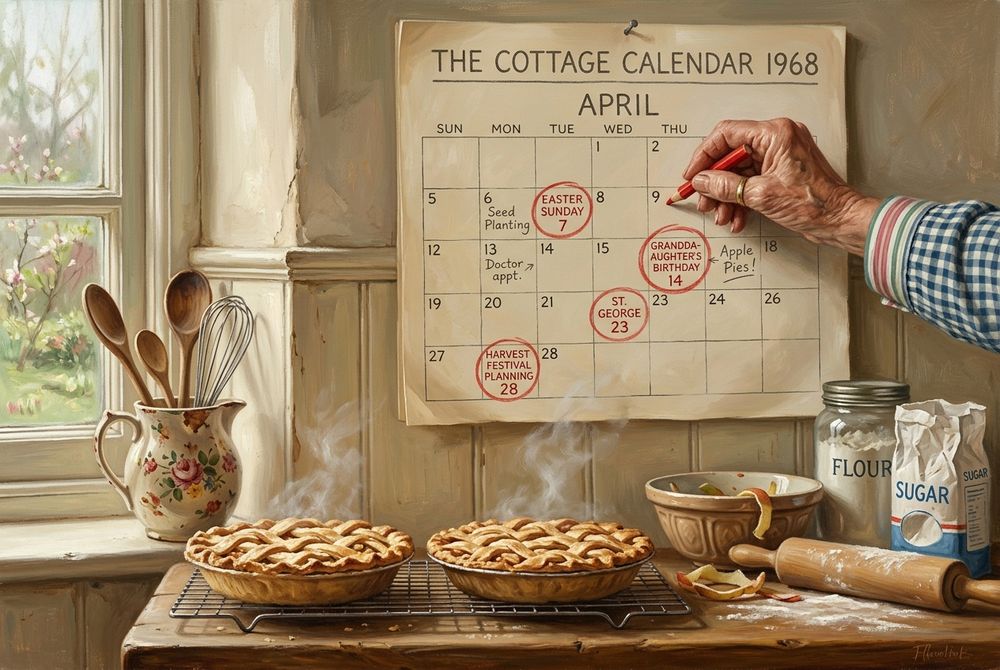
Feast days circled in red. The blank squares don’t run the household; the circled ones do. A calendar is mostly about the gatherings.
Day four hangs a calendar in the sky. This page follows the two words in the verse that say so, out through the rest of the Bible. Day four’s other question, who rules and what it means when Scripture puts the lights out, is walked out on the lights. Two pages, two questions: who rules, and what time it is.
Day four states its own purpose
Genesis rarely tells you what something is for. Here it does, in one clause. So the way to read day four is to ask what those two words mean everywhere else in Hebrew. Not what they could mean, but what they do mean in the hundreds of other places they show up.
Moed: the word for a set feast
Start with “seasons,” moed. In English that word makes you think of spring and autumn. Hebrew doesn’t use it that way. A moed is an appointment, a meeting somebody fixed. It shows up over two hundred times, and it piles up in Numbers, Leviticus, and Exodus. Here is the chapter that defines it.
That verse opens Israel’s festival calendar: Passover, Weeks, Trumpets, Atonement, Booths. The word your Bible translates “seasons” in Genesis 1:14 is the same word translated “feasts” here. Not a related word, the same one. And they are called my feasts: God’s appointments, not the farmer’s.
Leviticus doesn’t get the word first, though. Genesis uses it exactly four times, and the day-four verse is only one of them. The other three all say the same thing, long before there is an Israel to say it about:
Isaac’s birth. Everywhere Genesis itself uses the word, a moed is a date God fixes and keeps for the covenant. It is not a farmer’s season, and not yet a nation’s calendar. There was no Israel when God hung the lights up for this. Sinai is centuries away. Leviticus didn’t coin the word; it inherited a word day four had already hung in the sky.
One psalm reads day four back to us with this very word still in it.
Psalm 104 is a long poem about the making of the world. When it reaches the moon, it gives the moon the feast-word for a job. The Bible is commenting on day four in its own words: the moon hangs there to run the calendar of worship.
Ot: the word for a covenant token
Now “signs,” ot. An ot is a marker hung on a relationship, something visible that says an agreement is real. The Bible’s great covenants each get one, and the same little word carries all of them.
A rainbow, a cut, blood on a doorframe, a day of the week. Four different things, one job: each one stands where an agreement is, so nobody forgets it. That is the work ot does for a living. The luminaries of day four are made “for” that word.
Put the two words back in the verse
Now put Genesis 1:14 back together, with the rest of the Bible in your ear. The lights are set in the sky for covenant tokens and appointed feasts. Day four does not just put lamps up. It hangs a worship calendar over the world, long before there is an Israel to live by it. Centuries later, Israel does: new moons, festivals, the seventh day, all keeping a clock that was already running. The lamps are real. But the verse says first what they are for, and what they are for is the gathering. The gathering was built into the sky before there was anyone to gather.
GO DEEPER: More appointments, a shadow, and a retired calendar
Two more places moed turns up
Passover is to be kept “at his appointed season” (Numbers 9:2). That is moed again, the appointment on the sky’s own clock. And the tent where Israel met with God has this word in its name. The KJV calls it “the tabernacle of the congregation,” but the Hebrew behind “congregation” is moed. It is the tent of the appointed meeting (Exodus 27:21). One word covers the time God shows up and the place God shows up.
You can also hear what the word means by listening to it break. When Jerusalem falls, Lamentations does not say the harvest failed. It says: “The ways of Zion do mourn, because none come to the solemn feasts” (Lamentations 1:4). The roads are empty because the appointments stopped.
A shadow is thrown by something
Much later, Paul writes to a church that is being graded on its calendar-keeping: what they eat, what they drink, which days they mark. Here is how he defends them.
It is easy to hear a sneer in that which is not there. Paul does not call the feasts foolish. He does not say God wasted his time. He calls them a shadow, and a shadow is thrown by something. You never get the shadow of nothing. Something solid stood in the light, and the shape on the ground was the holy day, the new moon, the sabbath.
That fits what this whole page has been finding. A moed is an appointment. The feasts were appointed times, and Paul tells this church the appointment was kept: “the body is of Christ.” What he takes off the table is the judging, not the calendar.
When the calendar-keepers can retire
This one is gentle. The sun and moon are not shamed here, and they are not destroyed. They are simply not needed for this job any more. A calendar tells a household when the family gathers. When everyone is finally home, when God dwells with his people face to face, nobody needs to check the date. The calendar-keepers get to put their work down, not in disgrace but because the work is done.
Day 4’s own verse, drawn in the sky it describes: the lamps that keep the appointments.
Open the heavens →The sun, moon, and stars were set in the sky to give light and mark ordinary time: seasons of the year, days, and years.
Ot and moed are Scripture's words for covenant tokens and appointed feasts, so day four hangs a worship calendar in the sky first.
Genesis 1:14 says “and for days, and years” in the very same breath. The sky really does mark ordinary time, and farmers have planted by it for as long as there have been farmers. That is in the verse. This page points at the covenant weight these two words carry everywhere else in Hebrew, and the fact that the verse leads with them. Ot is a broad word. It also names wonders, warnings, and a mark set on Cain, so “sign” does not always mean “covenant token.” And moed can be used for a set time with no feast attached at all, as when Daniel speaks of an appointed end. Neither word by itself decides what day four is doing. It is the pair, in a purpose clause, that we think deserves a second look. Colossians 2 has its own limit. Careful readers argue over how far that sentence reaches: which practices Paul has in view, and what he is asking the church to do next. The whole thought is quoted above, shadow and body together, and the rest of that argument is not settled here.