Put on ἐνδύω & Deathless ἀθανασία
A tailor’s word, doing theology
Endyō is not a special word. It is what you say when somebody gets dressed. It clothes ordinary people all through the New Testament. John wears camel’s hair, the soldiers put Jesus’ own clothes back on him, a king sits in his royal robes (Acts 12:21). The best robe is brought out for a son who came home (Luke 15:22).
Then Paul gives that plain word something spiritual to wear. You put on Christ, the new man, armor, power, mercy, kindness. In his letters the thing put on is very often a standing, an identity, or a power handed to the wearer. It is not a change made to the wearer’s material. The verb dresses people. It does not remanufacture them.
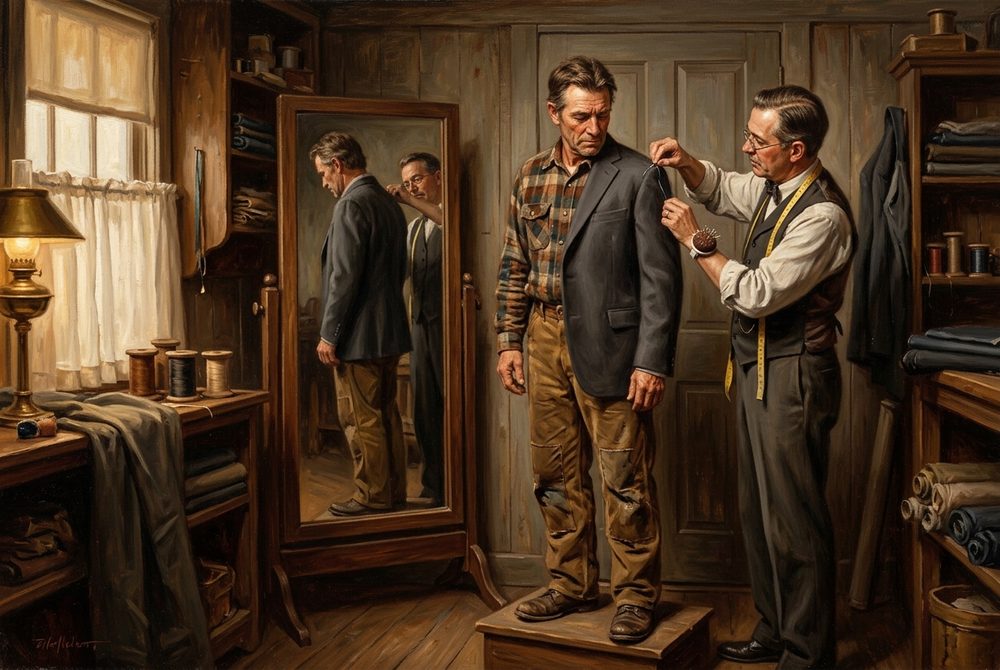
A man comes in from work and stands at the mirror while the tailor pins the sleeve. The work clothes were not patched or dyed. Something else went on over them, and now he is dressed for the wedding. Same man, new standing, and everybody at the door will know it at a glance.
The garden’s unfinished business
The clothing story does not start with Paul. It starts with two people who found out they were naked, sewed themselves something out of leaves, and hid.
One verse of pure kindness in the middle of a sentence being handed down. God makes the covering himself, and he puts it on them (the coats of skins). But that covering answers shame. It goes over the top of a problem that is still there. The exiles walk out of the garden dressed, and still dying.
Must put on
Same tailor’s verb, and now the garment is deathlessness. Athanasia is two pieces too: a-, not, and thanatos, death. The word means not-dying, and here it is worn like a coat.
That word appears three times in the whole New Testament, and the three sit well side by side. Twice it is here, something mortals must put on. The third time, Paul says of God that he “only hath immortality” (1 Timothy 6:16). Three uses is a small sample, and people weigh it differently. But the question stands: do you put on what you already have?
And then the funeral runs backwards
Death does not get patched up or negotiated with. It gets swallowed. The line Paul quotes is Isaiah’s, “he will swallow up death in victory” (Isaiah 25:8), a promise made long before and cashed here on the far side of a getting-dressed.
Already partly dressed
This one is the plain test case. Nobody reads Galatians 3:27 and thinks somebody’s tissue changed. Everybody hears what it says: a new standing, worn where people can see it. The same verb does the same kind of work in 1 Corinthians 15. That is a reason to read the resurrection promise as a real getting-dressed, not a metaphor with nothing under it.
So here is the wardrobe, end to end. In the garden, the stripped ones were dressed by God’s own hands. A covering was laid over shame, given to people on their way out the gate. At the dawn, the last Adam finishes the outfit. This time it is not a covering for shame. It is life, put on over dying.
GO DEEPER: Clothing as standing, in three more places
Not a question about skin
None of this clothing language is really about a body being seen. In the world the Bible was written in, clothes were not cheap. Going without meant something closer to having nothing than to feeling embarrassed. What clothing marked, far more often, was standing: an office, a covenant, a function nobody at the door could mistake.
The ring and the linen make Joseph a ruler on the spot, an office worn. Boaz’s cloak over Ruth is not modesty. It is a marriage claim, the same gesture God himself uses for Israel: “I spread my skirt over thee... and entered into a covenant with thee” (Ezekiel 16:8, and see coats of skins). A robe can make a king. A covering can make a bride. Neither is about what the body looked like underneath, and that is the question the next story turns on.
A man at a wedding, not dressed for it
Jesus told a story about a king throwing a wedding for his son. The first guests will not come, and the story turns hard, harder than most people remember. That part is not taken up here. In the end the servants are sent out to the roads to bring in whoever they find, “both bad and good.” The hall fills. Then the king comes in to look at his guests.
“Had not on” is endyō, the tailor’s word again, the plain one. (Strictly, the verb is the had…on part; the “not” is its own small Greek word beside it.) The man is not accused of anything he said, or anything he did at the table. The whole problem is what he is not wearing, and everyone in the room can see it at a glance. Inside this story, being dressed is a standing.
And he was speechless. There is nothing you can say about a standing you do not have.
Clothed upon, and Paul says why it matters
In verse 4 Paul goes out of his way to say what he is not asking for: to be unclothed, stripped. What he wants is to be clothed upon, a word with a little prefix meaning over the top, “that mortality might be swallowed up of life.” That is the same swallowing as 1 Corinthians 15, and the same direction. Life goes on over mortality, the way a coat goes on over a shivering man.
The clothing thread runs the length of the sky: coats of skins low in the dusk, deathlessness in the crown at dawn.
Open the dawn sky →The believer's physical body is raised and changed so that it can never die again; deathlessness becomes a property of the body itself.
Putting on works like a robe put on a king: deathlessness is conferred by the God who alone has it, not the wearer remade.
When and how this clothing is completed is a timing question this site leaves open, and a word study does not answer it. The clothing register is about Paul’s theological objects. The same verb dresses literal bodies in literal clothes all through the New Testament, so it shifts a presumption rather than proving a case. The tent-and-house language of 2 Corinthians 5 has several defensible readings. The common one takes the thing put on to be the resurrection body itself. Three occurrences of athanasia is thin evidence for any large claim, ours included. All three are on this page, so you can count them yourself. This page is about the resurrection body, not about what happens to a person between death and resurrection. Nothing here is a claim about the intermediate state, in any direction. The wedding story is a judgment parable. This page does not say who the king is, what the feast stands for, or when any of it happens. It borrows only the verb and the way clothing works inside the story. You will often hear that the host handed out garments at the door, so the man had no excuse. Matthew does not say that. It may be right about the custom, but it is not in the text, and this page does not lend it the text’s authority.